
Navigating the Techno-Future: Between Promise and Prudence
How to see the world through the lens of techno-neutrality and embrace a balanced view of the future.


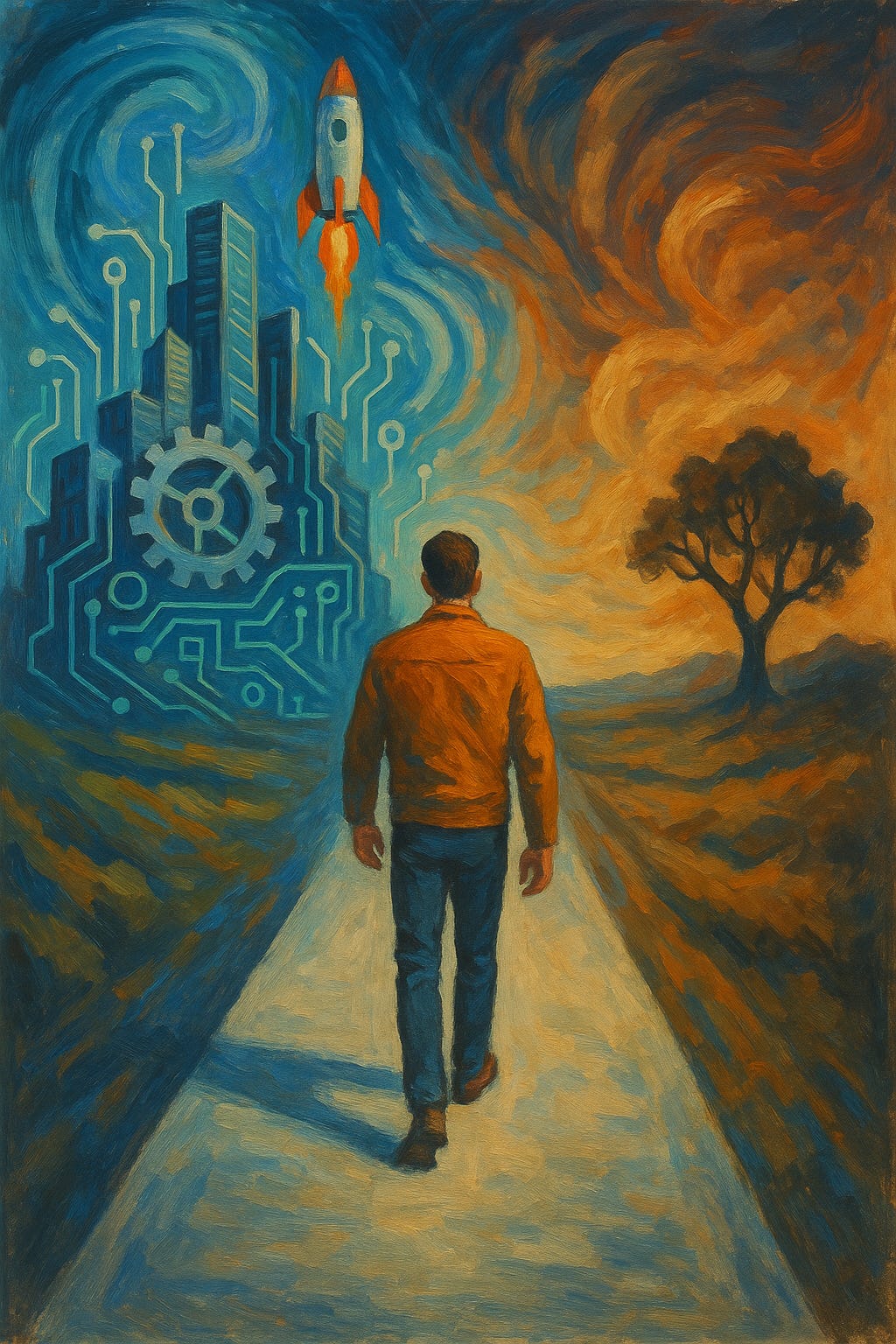
The Dawn of a Brand-New Epoch
Today I was lying back in my armchair, gazing at the endless blue sky, letting my thoughts wander freely.
Questions kept colliding in my mind, reflections emerging one after another, like sparks from a fire. I suddenly became acutely aware of the intrinsic power of humans: their ability to enact radical change, to shape the world, and to channel a constant flow of innovations that redefine life itself.
As I observed the quiet rhythm of the sky, I also found myself contemplating the intricate structure of our modern society. I tried, in my mind, to model possible futures: pathways that humanity might take, branching in countless directions, some clear, many uncertain.
I saw the constant tensions and torsions of our age: ongoing conflicts between nations, ideologies, and different visions of progress. I reflected on the major challenges that lie before us, and on the unknown paths that future generations will have to navigate, carrying the consequences of our choices today.
We stand, indeed, at a singular moment in human history. Never before have we wielded such technological power, nor have we faced challenges so tightly intertwined with the very tools we have created.
The machines, algorithms, and networks that once promised to simplify life now shape the most fundamental aspects of it. They basically dictate how we communicate, how we work, how we govern, and increasingly, even how we think.
There is a natural tension here: on one hand, our tools are the greatest enablers humanity has ever known. On the other, their misuse, or even their unconsidered deployment, carries risks that few generations have had to grapple with.
This is not the story of technology as destiny, nor a tale of inevitable doom. Rather, it is a reflection on the techno-future: one where humanity retains agency, makes conscious trade-offs, and strives for a world in which technological power is harmonized with human flourishing.
Miracles of Human Ingenuity
Consider the world we inhabit today. Life expectancy has doubled in the past century.
Diseases that once decimated populations, like for example smallpox, polio, even certain forms of cancer, have been contained or cured through scientific ingenuity. Literacy rates are at historic highs.
Access to information, once the privilege of a few scholars, is now available to billions 24/7, at the tap of a finger.
Technological progress is not merely convenience: it is a form of liberation.
Renewable energy innovations allow some societies to imagine decoupling economic growth from environmental destruction. Biotechnology holds the promise of eliminating hereditary diseases and extending human vitality.
AI and automation offer the potential to free humans from repetitive, unsafe, or soul-draining labor.
Connectivity, once a dream of science fiction, is now a global fact, enabling cross-cultural dialogue, remote collaboration, and shared knowledge on a scale previously unimaginable.
Yet, the story of human ingenuity is not just one of triumph. It is a tale that reminds us that tools amplify human intention, for better and worse. The same digital networks that connect us can also propagate misinformation. Algorithms designed to optimize engagement can unintentionally manipulate behavior.
Industrial innovation that built our modern economy has also contributed to climate change and environmental degradation.
It is this duality (the capacity for both creation and destruction) that defines our technological epoch. And it is that thing that fascinates me a lot.
An Illusion of Determinism
In discussions about the future, extremes often dominate. On one side are the techno-optimists: the believers in inexorable progress, the proponents of markets and innovation as self-correcting forces. They see every challenge as a technical problem and every failure as a design flaw waiting to be solved.
On the other side are techno-pessimists: the prophets of collapse who warn that every new tool will inevitably accelerate inequality, erode democracy, or catalyze ecological catastrophe. They see history as a cautionary tale, and the present as a fragile prelude to systemic failure.
Both perspectives share a common flaw: they treat the future as preordained. Optimists assume that progress will automatically yield good outcomes; pessimists assume that progress will inevitably lead to harm. Reality, however, is far less deterministic. Technology, in itself, is neutral. It amplifies human choices but does not dictate them.
If we look deeper, the forces shaping society bear striking resemblance to principles from physics. Just as in thermodynamics, where entropy measures disorder and the inevitable drift toward chaos, our social systems contain inherent instability.
Information spreads unevenly, markets fluctuate, alliances shift, and unintended consequences ripple across populations.
Small perturbations, like a viral tweet, a technological breakthrough, a regulatory change, can cascade unpredictably, reminiscent of chaos theory, where tiny differences in initial conditions produce vastly divergent outcomes.
Yet, as in physics, patterns emerge amidst the apparent disorder. Societies exhibit self-organizing tendencies, resilient networks form, and feedback loops (both positive and negative) regulate behavior over time.
Technology, then, acts as both a catalyst and a medium for these dynamics, amplifying the chaotic yet patterned energy of human activity.
Understanding these parallels is pretty crucial. It reminds us that the shape of the future is contingent, not fated.
We are not passive observers of a predetermined trajectory; we need to be participants in a complex system, capable of nudging outcomes while remaining subject to emergent dynamics.
Policies, ethical norms, social contracts, and civic engagement are our instruments to reduce harm, amplify benefits, and guide the system toward more favorable equilibria.
The challenge, therefore, is not merely to predict the future but to navigate it with awareness of both chaos and order, to recognize the entropic tendencies inherent in complex systems, and to act responsibly within them.
In a world governed by the interplay of innovation, human intention, and the inexorable laws of complexity, agency and foresight are our only stabilizing forces.
Embracing Technological Neutrality
Adopting a semi-positive perspective does not mean blind optimism or uncritical celebration of innovation.
It is not the naive belief that every technological breakthrough will automatically make the world better, nor is it the pessimistic assumption that every new tool will inevitably cause harm.
Rather, it is an approach grounded in reflection, pragmatism, and the recognition of human agency: understanding that technology is a tool, and that its effects depend largely on how we deploy it.
A useful lens for this perspective is technological neutrality. This concept emphasizes that technologies, in themselves, are neither inherently good nor inherently evil.
They are instruments (amplifiers of human intention) whose moral and societal value is contingent upon the context in which they are used.
Just as a hammer can build a home or inflict injury, a powerful technology like artificial intelligence, gene editing, or blockchain can be used to improve lives or to exacerbate inequalities. The technology does not prescribe its use; humans do.
This neutrality is both liberating and daunting. On the one hand, it affirms that progress is not predestined. The future is not a straight line determined by the mere existence of certain tools.
Human societies retain the capacity to guide the trajectory of technological change through thoughtful regulation, ethical reflection, and social oversight.
On the other hand, it underscores the responsibility we bear: since technology amplifies intention, missteps are magnified, and neglect can have cascading effects, particularly in complex, interconnected systems.
Take AI as a concrete example. Artificial intelligence can revolutionize healthcare by identifying diseases earlier and more accurately, personalize education to meet the unique needs of each student, optimize logistics to reduce waste and environmental impact, and accelerate scientific discovery at a speed unimaginable just decades ago.
Yet, the same AI systems can entrench bias, concentrate power in the hands of a few global corporations or governments, erode privacy, and even manipulate behavior on a massive scale.
The technology itself does not dictate these outcomes; rather, they arise from how humans design, implement, and govern these systems.
Recognizing neutrality reframes how we think about innovation. It moves the debate away from simplistic “good versus evil” narratives and toward a more nuanced understanding: technologies are tools, ecosystems of human intention, incentives, and constraints.
The moral and practical evaluation of technology must consider the broader social, economic, and ecological context in which it is embedded.
For example, a self-driving car may be neutral as a machine, but its deployment affects urban planning, labor markets, environmental emissions, and even legal systems. These downstream effects are not determined by the technology itself but by human choices surrounding its use.
A semi-positive view, therefore, emphasizes deliberate stewardship. It advocates for rigorous assessment of potential benefits and harms before widespread adoption, constant monitoring of outcomes, and the readiness to adapt policies or practices as new insights emerge.
It acknowledges that technology’s neutrality is not a shield for passivity; rather, it is a call to action. Neutrality does not absolve society from responsibility; it magnifies it, because the consequences of inaction can be just as significant as those of misuse.
Furthermore, embracing neutrality encourages us to see innovation as a collaborative enterprise rather than a deterministic force. Engineers, scientists, policymakers, educators, and citizens all participate in shaping outcomes.
A neutral technology can be steered toward inclusion, sustainability, and well-being (or toward the opposite) depending on collective intent, incentives, and governance.
This perspective is particularly relevant in complex systems, where small decisions can cascade unpredictably, and where ethical, social, and environmental considerations cannot be separated from technical design.
In practice, technological neutrality invites a mindset of responsible experimentation.
It promotes designing systems with fail-safes, transparency, and feedback loops, ensuring that tools remain aligned with human values as contexts change.
It emphasizes education and empowerment, so that individuals and communities can engage critically with technology, making informed decisions rather than being passive recipients.
Most importantly, it frames technology as a means rather than an end: the goal is not technological sophistication for its own sake, but the enhancement of human and planetary flourishing.
Technology magnifies human intention, but it is humans who bear the responsibility to shape, govern, and contextualize its deployment.
By understanding and embracing this neutrality, society can navigate a path that maximizes progress, minimizes harm, and ensures that innovation serves the collective good, now and for future generations.
Trade-Offs Are Inevitable
Every era of human progress has been shaped by the same paradox: what empowers also constrains; what liberates also binds. Technology magnifies both sides of human intention.
The printing press spread knowledge but also propaganda. The combustion engine brought mobility but also climate risk. The internet connected the world and fractured it at once.
The key insight of the technological age is that there are no free optimizations. Every system improvement shifts cost or complexity elsewhere. When a machine becomes more efficient, it consumes new kinds of resources, like data, energy, or attention.
When software simplifies our lives, it may also invisibly constrain them through algorithmic design.
Social media illustrates this trade-off vividly. It democratized speech and collapsed distances, but in doing so, it also compressed nuance and accelerated outrage. The architecture of virality rewards emotional intensity over deliberation.
In this sense, the challenge is not rejection, but refinement: designing tools that amplify truth and empathy as effectively as they amplify engagement.
The same is true of renewable energy, biotechnology, or automation. Wind farms may alter migration routes of birds; solar panels require rare minerals mined under harsh labor conditions;
CRISPR may cure diseases but blur the boundaries of what it means to be human. None of these outcomes invalidate progress, they simply demand maturity.
Progress without reflection risks becoming self-defeating; reflection without courage risks paralysis. The semi-positive stance stands between these extremes: a steady gaze toward what technology enables, coupled with an honest reckoning of what it costs.
Responsibility as a Collective Endeavor
In the past, responsibility could often be localized: an engineer built a bridge, a physician treated a patient, a policymaker drafted a law. But in a networked world, causality disperses.
A line of code written in Silicon Valley affects political discourse in Delhi. An algorithmic bias in a hiring system can reinforce inequality globally.
If technology amplifies human intention, shared responsibility becomes the foundation of ethical progress. No single actor (neither corporation nor government) can bear the weight alone.
Innovation today exists in vast interdependent ecosystems: scientists who discover, engineers who implement, educators who shape norms, regulators who safeguard the commons, and citizens who participate or resist.
Collective responsibility requires coordination, transparency, and the cultivation of shared values. Consider climate change: no invention, no matter how elegant, can undo systemic inertia without collective will.
The same actually applies to artificial intelligence. Technical alignment is meaningless without institutional and moral alignment.
The semi-positive perspective sees responsibility not as a constraint, but as an organizing principle for agency. Responsibility is how freedom sustains itself over time.
It transforms technological power from a zero-sum race into a collaborative project: a civilizational effort to align intelligence, both human and artificial, with the flourishing of life.
Equity and Accessibility
Technological innovation often follows an uneven geography. Wealthy nations and urban centers absorb the first benefits; marginalized regions receive the residuals.
Broadband access, clean energy, vaccines, and education: all those game-changers technologies remain profoundly unequal across the world.
A semi-positive vision refuses to treat this inequity as inevitable. It insists that progress must be shared to be real. Open-source software, public data infrastructures, and community-driven innovation exemplify how technology can decentralize power.
Projects like Wikipedia, Linux, and the global open-science movement prove that collective knowledge can scale without monopolistic control.
Yet inequality persists even within digital spaces. AI models trained on biased data risk encoding structural injustices into automated systems.
Predictive policing, credit scoring, and hiring algorithms can perpetuate historical disadvantages under the guise of objectivity. Therefore, accessibility is not merely about availability, it is about justice.
A truly inclusive techno-future designs not just for efficiency, but for dignity. It asks:
who benefits, who bears the cost, and who decides?
When equity becomes a design constraint rather than an afterthought, technology transforms from a mirror of privilege into an instrument of participation.
Embracing Uncertainty and Continuous Learning
Every major innovation has carried consequences that no one foresaw. The creators of the automobile did not anticipate gridlock and smog.
The architects of the internet did not foresee misinformation economies. The inventors of antibiotics could not predict resistant superbugs.
The lesson is humility. In complex adaptive systems (ecological, social, or technological) no model can predict all feedback loops.
The semi-positive mindset accepts uncertainty as a structural condition of progress. Instead of paralyzing us, uncertainty can become a source of creative vigilance.
Continuous learning, then, is not a slogan: it is a civic virtue. Policymakers must design adaptive regulations that evolve with evidence. Technologists must build feedback channels to detect harm early and iterate designs.
Educators must teach meta-skills: critical thinking, digital literacy, and moral reasoning alongside coding or data science.
A resilient society is not one that avoids mistakes but one that learns faster than it breaks.
The semi-positive view replaces the myth of mastery with a culture of stewardship: progress as a continuous dialogue between innovation and reflection.
The Role of Ethics in Shaping the Future
Ethics is often treated as a brake on progress, a set of constraints applied after innovation occurs. But in reality, ethics is the architecture of trust. Without it, even the most advanced technologies fail to sustain legitimacy.
From nuclear energy to AI, ethical reflection must precede and accompany invention. This means embedding moral reasoning into every layer of the innovation process: conceptualization, data collection, design, deployment, and evaluation.
For instance, ethical AI frameworks that integrate fairness, accountability, and transparency can turn regulatory compliance into competitive advantage. Biomedical ethics ensures that the power to edit genes serves healing rather than hubris.
Ethics, to be effective, must be practical, evidence-based, and globally informed. It must engage pluralism without surrendering universality, recognizing diverse cultural norms while upholding human dignity as a shared baseline.
The goal is not moral perfection but moral orientation: a compass that guides technology toward what is desirable, sustainable, and just.
Agency, Prudence, and Hope
The future is not an algorithmic output: it is a human project.
Every choice basically feeds into a broader narrative of civilization. The semi-positive lens rejects both techno-utopianism and techno-pessimism.
Instead, it affirms agency: the belief that we are not spectators of the future but its co-authors.
Prudence is the virtue that balances courage with caution. It reminds innovators that speed without reflection breeds fragility, and that long-term resilience depends on aligning technological ambition with ethical foresight.
Hope, finally, is not a mood: it is a discipline. It means acting as though a better world is possible, even when evidence is incomplete. It is the emotional engine of responsible progress.
Technology alone cannot guarantee a good future. But when guided by agency, prudence, and hope, it can become one of humanity’s greatest instruments for flourishing.
The techno-future is a blank canvas. Whether it becomes a dystopia of control or a renaissance of wisdom depends on our willingness to act with care, imagination, and shared purpose.